“We’re too small for hackers to care about us.”
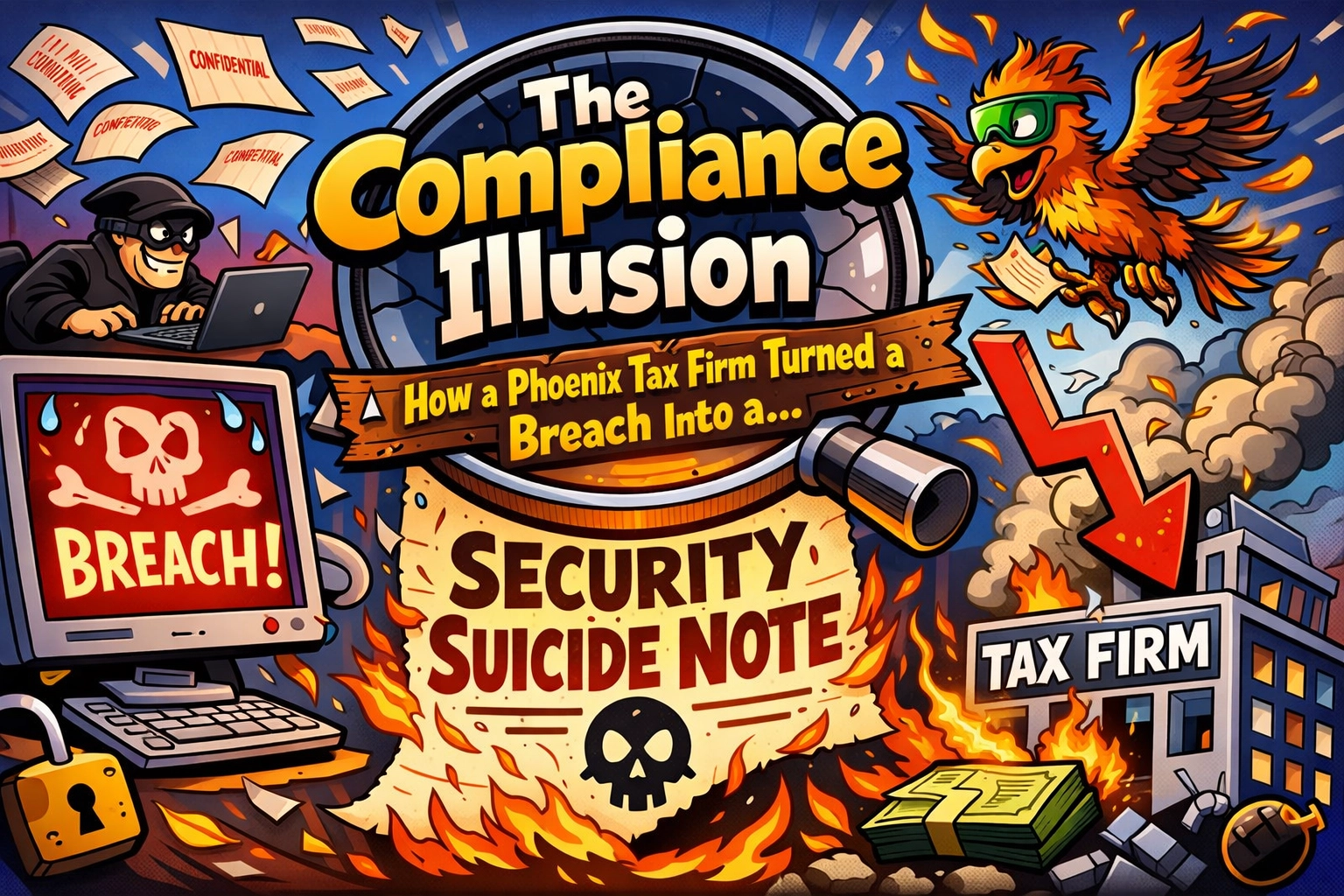
If I had a dollar for every time a Phoenix CPA or mortgage broker told me that, I could retire tomorrow. And every single time, I want to pull up the data and say: You’re not too small to notice. You’re perfect size to rob.
Here’s the uncomfortable truth that nobody wants to talk about at Chamber of Commerce mixers: 43% of all cyberattacks against businesses with 1-10 employees are successful. Not “attempted.” Successful. That means nearly half the time a hacker targets a micro-business, they walk away with your data, your money, or both.
Meanwhile, mid-size companies (11-100 users) only get breached 18% of the time. Why? Because they have actual security. You don’t.
The Micro-Business Myth: Why You’re Actually Easiest Target
Let’s kill the fantasy right now: Hackers don’t care about your brand name. They care about effort vs. reward. And a 5-person Valley insurance agency with no IT staff, no MFA, and a shared Gmail account is a $120,000 payday that takes about 20 minutes of work.
That’s not a hypothetical number. The average recovery cost for a micro-business breach is $120,000+, and that’s if you survive at all. Most don’t. Roughly 60% of small businesses close within six months of being breached, not because of the hack itself, but because clients leave, insurance premiums skyrocket, and reputation damage becomes permanent.
Still think you’re flying under the radar? Let me show you exactly how this plays out in real life.
Four Recent Micro-Business Breaches (And How They Happened)
1. The Franchise That Got “RansomHub’d”
In August 2025 (confirmed August 2025), an independently owned Manpower franchise in Lansing, Michigan, yes, a franchise location, not corporate giant, got hit by a RansomHub ransomware group. The attackers didn’t need to break down any firewalls. They just walked in through an unmonitored remote access tool and exfiltrated 500GB of data: Social Security numbers, passport scans, financial statements, works.
Then they encrypted everything and left a ransom note.
The vulnerability? No EDR. No monitoring. Just a small office that assumed “corporate handles security.”
2. The AI-Phishing Epidemic
By 2025 (2025 data), 41% of small business breach victims reported that AI was root cause. Not some sci-fi terminator stuff, just ChatGPT-style tools that let attackers craft emails so personalized, they look like they came from your actual boss.
One Phoenix real estate office got hit with a “vendor payment update” email that perfectly mimicked their title company’s tone, included the correct escrow file number, and requested a wire transfer to a “new” account. The assistant sent $40,000 before anyone realized the email domain was off by one letter.
The vulnerability? No email security layer to detect linguistic anomalies. No DLP to flag wire instructions before they left the building.
3. The OAuth “Leapfrog” Attack
Here’s a sneaky one: In 2025 (2025 attacks), hackers started targeting third-party tools like Salesloft, Drift, and Gainsight, not to steal data directly, but to steal OAuth tokens (the digital keys that let you “log in with Google”).
Once they had those tokens, they leapfrogged into hundreds of connected small businesses without ever triggering a single password alert. No phishing email. No malware. Just a stolen key.
The vulnerability? No monitoring of third-party app permissions. Most micro-businesses have no idea how many “integrations” their team has authorized.
4. The Warlock Ransomware Exploit (February 2026)
This is happening right now (February 2026): Warlock ransomware group is exploiting a vulnerability in SmarterTools systems (CVE-2026-23760) that was patched two weeks earlier. But here’s the kicker: most small businesses don’t patch immediately because they’re terrified of downtime.
So Warlock used a password reset exploit to take over admin accounts, then deployed ransomware across every unpatched system they could find.
The vulnerability? No patch management process. No EDR to detect “admin account suddenly encrypting 10,000 files” behavior.
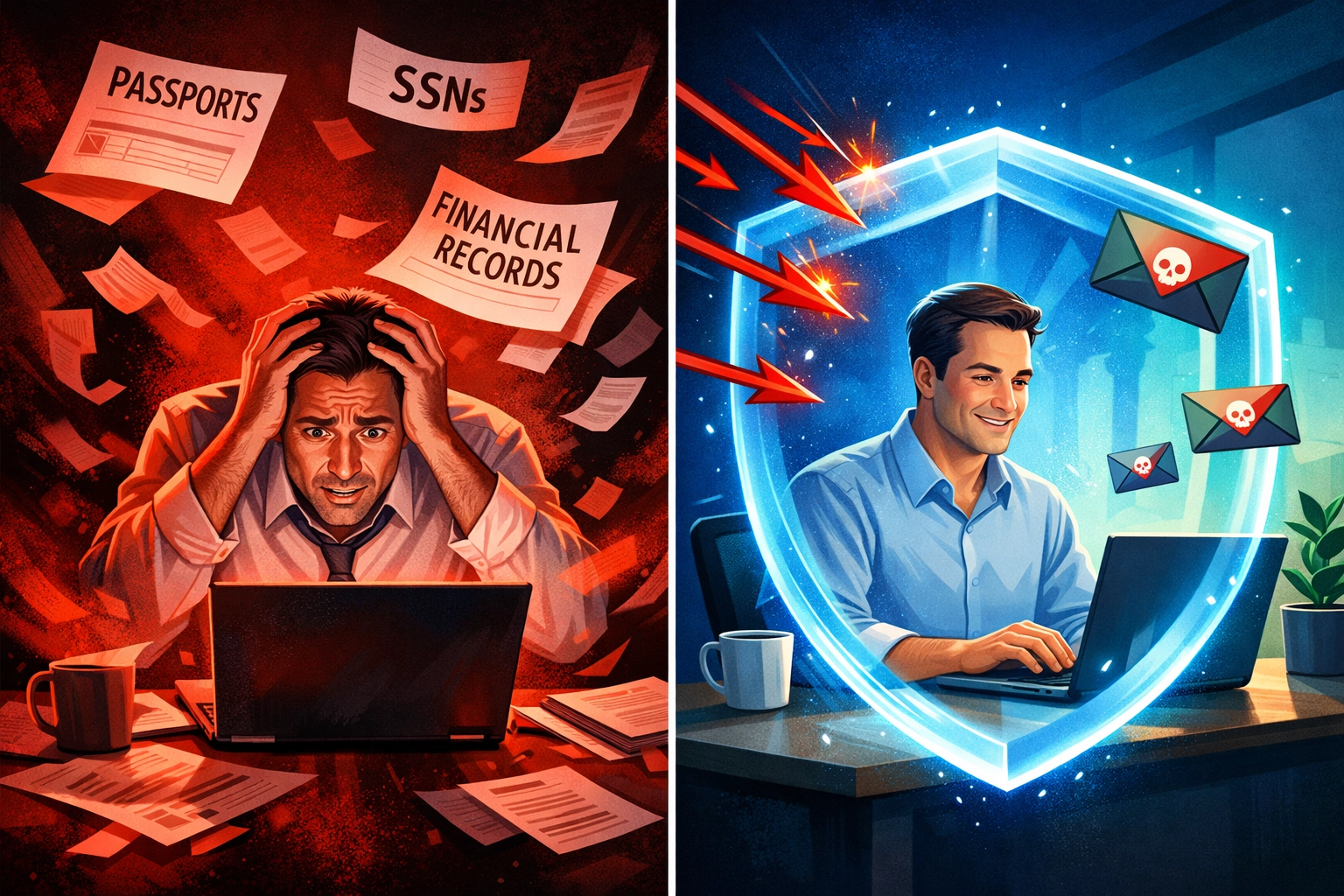
The Shield Strategy: The Triple Threat Stack
Okay, enough doom. Let’s talk solutions: and I’m not going to tell you to “hire a CISO” or “build a SOC.” You’re a 5-person team. You need practical, layered defenses that actually stop the attacks I just described.
Layer 1: Anti-Phishing / BEC / DLP (The Front Door)
Effectiveness: 90-95% of initial entry attempts.
Email is the front door for over 90% of all cyberattacks. A tool like Avanan (or Checkpoint Harmony, or Microsoft Defender for Office 365 E5) sits inside your email and scans every message after it passes your spam filter.
It looks for:
- Linguistic anomalies (Is this “invoice” phrased like your actual vendor?)
- Suspicious links (Is this URL pretending to be DocuSign?)
- Data leakage (Is someone about to email a bank account number in plaintext?)
If it detects a threat, it quarantines the email before your assistant clicks it. If it detects sensitive data leaving, it automatically encrypts it or blocks the send.
Real-world win: A Scottsdale mortgage broker’s team almost wired $85,000 to a fake escrow account. Their email security flagged the domain mismatch and stopped the email from ever reaching the inbox.
Layer 2: EDR (The Security Guard on Every Laptop)
Effectiveness: 80% of malware and “hands-on-keyboard” hacking.
Old antivirus (Norton, McAfee) looks for known bad files. EDR (Endpoint Detection and Response) like SentinelOne or CrowdStrike looks for bad behavior.
Why is Excel trying to download a PowerShell script from a Russian IP? Why is Word suddenly encrypting 10,000 files? EDR kills the process, rolls back the changes, and sends an alert: before your files are gone.
Real-world win: A Phoenix CPA firm’s laptop got infected with ransomware via a fake QuickBooks update. Their EDR detected the mass-encryption behavior, killed the process, and restored the files automatically. Total damage: zero.
Layer 3: Full Disk Encryption (The Physical Theft Nuke)
Effectiveness: ~100% of physical theft data breaches.
If your laptop gets stolen from a Starbucks, full disk encryption (BitLocker on Windows, FileVault on Mac) makes the data mathematically impossible to read without the password.
This is the difference between “We lost a laptop and have to notify 5,000 clients” and “We lost a laptop and it’s just an insurance claim.”
Real-world win: A Valley real estate agent’s car was broken into at a gym. Her laptop had full disk encryption. The thief got a $1,200 laptop. The agent didn’t have to report a single data breach.
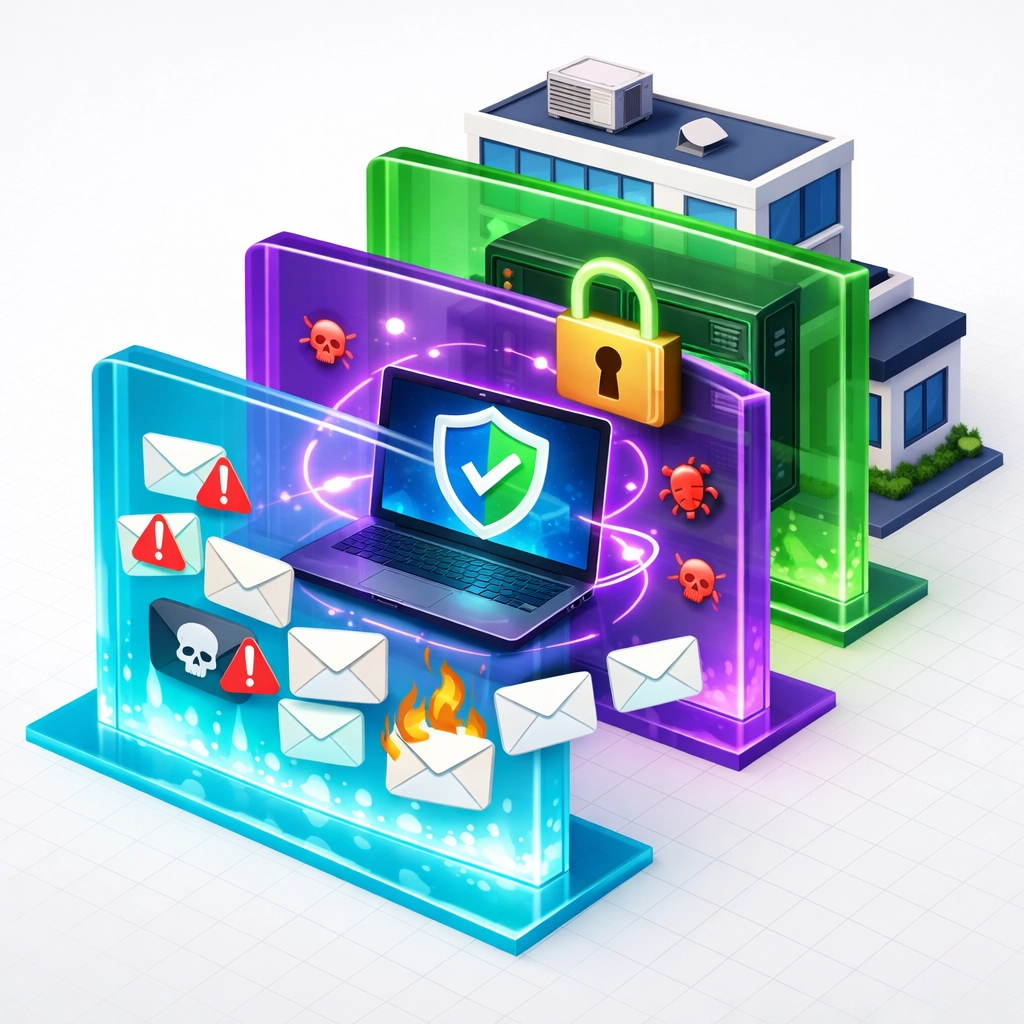
The Cumulative Effect: 98-99% Protection
When you combine these three layers, you’re not just adding percentages: you’re creating defense in depth:
| Security Layer | Primary Defense | Effectiveness |
|---|---|---|
| Email Security (Avanan-style) | Phishing, BEC, data leakage | 90-95% |
| EDR (SentinelOne-style) | Ransomware, malware, zero-days | 80% |
| Full Disk Encryption | Physical theft, lost devices | 99% |
| TOTAL COMBINED | The “Average” Cyberattack | 98-99% |
Is it perfect? No. There’s still the Critical 1%:
- MFA fatigue bypass (when an employee accidentally approves a login they didn’t trigger)
- Zero-day vulnerabilities (brand-new flaws that haven’t been patched yet)
- Malicious insiders (an employee who wants to steal data)
But here’s the thing: You don’t need perfect. You need “harder than the guy next door.” Because hackers are lazy. If you have MFA, EDR and encrypted email, and your competitor has Gmail and Norton, guess who’s getting breached?
The Phoenix Reality Check
I work with a lot of Valley businesses: CPAs during tax season, mortgage brokers during rate drops, law firms juggling 50 cases. And the pushback is always the same: “We don’t have the budget.”
Let’s do the math:
- Anti-phishing/DLP: ~$10-15/user/month
- EDR: ~$8-12/user/month
- Full disk encryption: Free (built into Windows/Mac)
For a 5-person team, that’s $90-135/month.
The alternative is a $120,000+ breach and possibly closing your doors.
Not exactly a tough ROI calculation.
Stop Being the Easy Target
You can keep telling yourself you’re “too small to notice,” or you can look at the data: 43% success rate, $120,000 average cost, 60% closure rate.
The hackers aren’t going away. The AI-phishing tools are getting better. The ransomware groups are getting faster.
But the good news? You don’t need a massive IT department or a six-figure security budget. You just need three layers that actually work: and the willingness to admit that “nothing’s happened yet” isn’t a security strategy.
If you’re ready to stop gambling with your business, let’s talk. We help Phoenix-area micro-businesses implement exactly this stack: no fluff, no upsells, just defenses that actually stop the attacks I described above.
Book a free Shield Strategy call here. Let’s make sure you’re not the next statistic.