You pay for health insurance hoping you'll never need it. You pay for car insurance because it's required and you pray you'll never file a claim. You pay for professional liability insurance and cross your fingers that no client ever sues you.
Every month, these payments disappear from your bank account: protection against disasters you hope will never happen. They're necessary evils. Safety nets that cost money but never make you money.
But here's where most Phoenix business owners get it completely wrong: they treat cybersecurity the same way.
They see MSP cybersecurity services as another monthly bill. Another "insurance premium" that protects against something bad but doesn't contribute to the bottom line. Just another cost of doing business in 2026.
That thinking is not only wrong: it's costing you money every single day you believe it.
Unlike every other type of protection you pay for, cybersecurity through a competent MSP doesn't just prevent losses. It actively generates returns. It saves you money, makes you money, and frees up your time to focus on what actually grows your business.
Let me show you exactly how: and why treating cyber as "just another bill" is one of the costliest mistakes Phoenix business owners make.
Why You'll Pay for Health Insurance But Balk at Cybersecurity
Here's the psychology that's sabotaging your business: You understand health insurance because you've been to the doctor. You've seen the bills. You know exactly what an emergency room visit costs without coverage.
You understand car insurance because you've either been in an accident or know someone who has. You can visualize the damage: the crumpled metal, the repair estimates, the rental car fees.
But cybersecurity? Most business owners haven't been breached yet. They haven't watched their business grind to a halt while systems are rebuilt. They haven't tried to explain to clients why their confidential data is now for sale on the dark web.
So they think: "Maybe I'll get lucky. Maybe it won't happen to me."

Meanwhile, they're paying $400/month for health insurance they might never use, $200/month for car insurance on vehicles that might never get in an accident, and $300/month for liability coverage on claims that might never be filed.
But when an MSP quotes them $500/month for comprehensive cybersecurity, automation, and IT management: services that will save them time and money every single month: suddenly they're shopping around for the cheapest option.
It's backwards thinking. And it's expensive backwards thinking.
The Expensive Fallacy: Treating Cybersecurity Like Every Other Bill
When you treat cybersecurity as "just another monthly expense," you make decisions based on the wrong criteria. You shop for the cheapest option. You look for ways to cut corners. You ask questions like:
- "Do we really need all these features?"
- "Can we get by with something simpler?"
- "What's the bare minimum that keeps us 'protected'?"
Those are the wrong questions because they're based on the wrong assumption: that cybersecurity is a cost center.
Here's the truth: Properly implemented MSP cybersecurity is a profit center.
Every month, it should be:
- Reducing your operational costs
- Preventing expensive downtime
- Automating time-consuming tasks
- Eliminating the need to hire additional support staff
- Protecting revenue streams from disruption
- Building customer confidence that drives sales
When you approach it as a cost center, you get cost-center results: minimum protection at minimum cost. When you approach it as an investment, you get investment returns: measurable improvements to your bottom line.
The ROI Drivers: How Cybersecurity Actually Makes You Money
Let me break down exactly how competent MSP cybersecurity generates returns: not someday, not if you're lucky, but every single month:
Automation Eliminates Labor Costs
Your team spends hours every week on tasks that should be automated: password resets, software updates, data backups, system monitoring, routine maintenance. At $25/hour for admin time, that's $500-1,000 monthly in wasted labor.
A proper MSP setup automates these tasks completely. Your team focuses on revenue-generating activities instead of digital busywork.
Prevention Eliminates Crisis Costs
Cyber incidents don't just cost money: they devour it. Recovery, reconstruction, legal fees, notification requirements, compliance penalties. But more importantly, they steal your time when you should be running your business.
24/7 monitoring and proactive threat response prevents these incidents before they escalate. You never pay the crisis costs because the crises never happen.
Compliance Protects Revenue Streams
Many contracts now require cybersecurity attestations. Healthcare clients need HIPAA compliance. Financial services require specific data protection standards. Legal firms need confidentiality safeguards.
Without proper cybersecurity documentation, you can't bid on these higher-value contracts. With it, you qualify for premium work that pays better rates.
Uptime Protects Existing Revenue
Every hour your systems are down, you're losing money. If your business generates $1,000 per hour in productive activity, a half-day outage costs $4,000 in lost revenue: plus the cost of getting back online.
Robust cybersecurity includes redundancy, backup systems, and rapid recovery protocols that minimize downtime to minutes instead of hours.
Real Phoenix Businesses, Real Financial Results
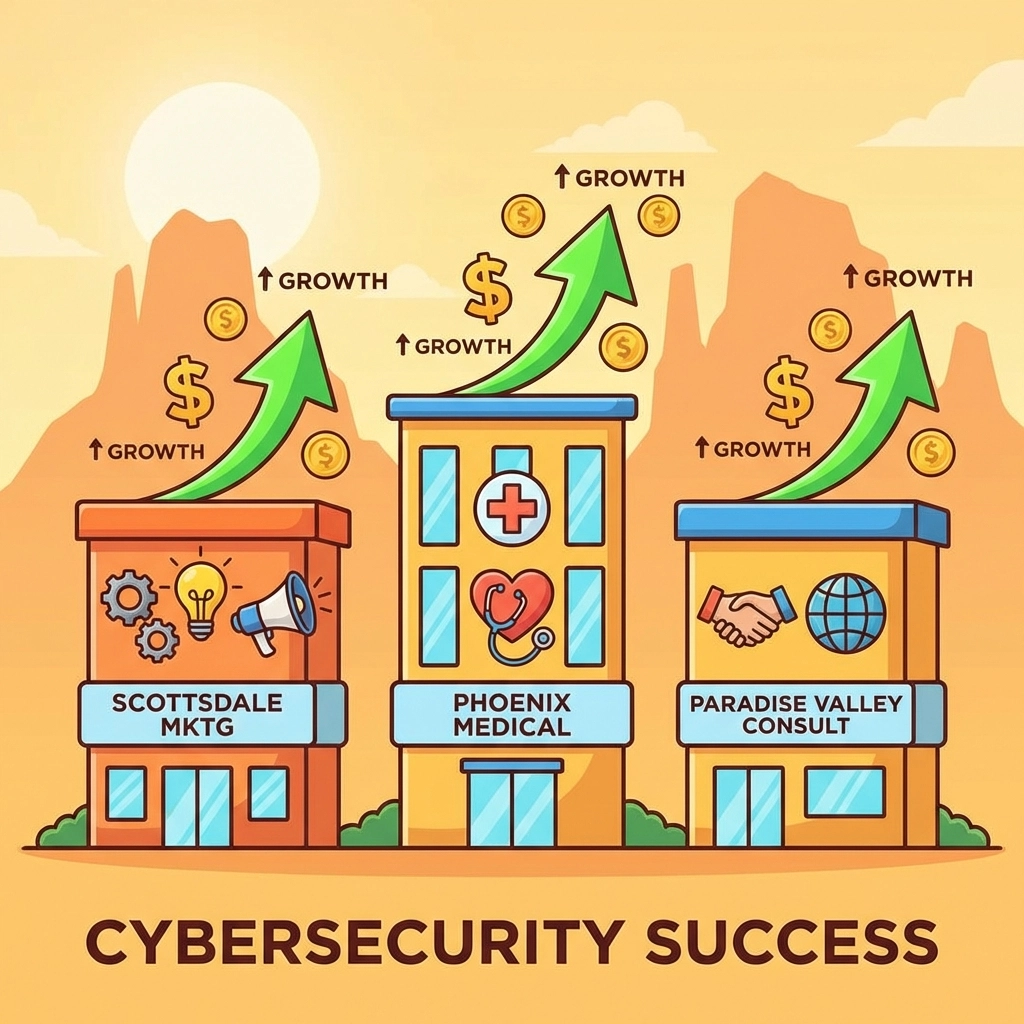
Let me tell you about three local businesses and how properly implemented MSP cybersecurity changed their financials:
Scottsdale Marketing Agency (12 employees)
- Before: Spending 15 hours/week on IT issues, security scares, and system maintenance
- After: Automated monitoring, proactive maintenance, integrated security
- Result: Freed up 60 hours/month of billable time worth $9,000 in additional revenue
Phoenix Medical Practice (8 employees)
- Before: Failed compliance audit, couldn't accept certain insurance contracts
- After: Full HIPAA cybersecurity implementation with documentation
- Result: Qualified for three new insurance networks worth $40,000 annually in additional patient revenue
Paradise Valley Consulting Firm (5 employees)
- Before: Lost a $50,000 contract due to inadequate data security requirements
- After: Implemented enterprise-grade security with compliance reporting
- Result: Won back similar contract plus two additional clients specifically because of security posture
These aren't feel-good stories. These are financial transformations that happened because these business owners stopped thinking about cybersecurity as "insurance" and started treating it as business infrastructure.
What You Actually Lose by Skipping Professional Cybersecurity
The opportunity cost of inadequate cybersecurity isn't just about breach risk. It's about everything you can't do while you're managing IT issues instead of growing your business:
Time Opportunity Cost
Every hour you spend dealing with IT problems is an hour not spent on sales, strategy, or customer development. At executive rates, that's $100-200 per hour in opportunity cost.
Revenue Opportunity Cost
Contracts you can't bid on because you lack security certifications. Clients you can't serve because you can't meet their data protection requirements. Growth opportunities you miss because your systems can't scale reliably.
Operational Efficiency Cost
Manual processes that should be automated. Redundant systems that should be integrated. Data scattered across platforms that should flow seamlessly. Each inefficiency compounds monthly.
Risk Amplification Cost
The longer you operate without proper cybersecurity, the more valuable your business becomes as a target. More data, more clients, more revenue streams: all unprotected and increasingly attractive to threat actors.
How to Treat Cybersecurity as the Only 'Insurance' That Pays Dividends
Here's how to shift your thinking and your approach:
1. Measure ROI, Not Just Costs
Track time saved through automation. Calculate revenue protected through uptime. Document contract opportunities enabled through compliance. Measure the actual financial returns, not just the monthly bill.
2. Think Integration, Not Protection
Don't ask: "How do we secure what we have?" Ask: "How do we build security into everything we do so it accelerates our business instead of slowing it down?"
3. Partner for Growth, Not Just Defense
Work with an MSP that understands your business goals and aligns cybersecurity with growth objectives. Your Personal Ninja doesn't just protect your current operations: we build technology foundations that support expansion, efficiency, and competitive advantage.
4. Plan Infrastructure, Not Just Incidents
Most businesses plan for what happens when things go wrong. Smart businesses plan for what happens when things go right: when you win big contracts, add new locations, or scale quickly. Your cybersecurity should enable that growth, not limit it.
5. Document Value Creation
Keep records of time saved, costs avoided, and opportunities captured because of your cybersecurity investments. This documentation justifies continued investment and guides optimization decisions.
The bottom line is simple: You wouldn't cancel health insurance because the monthly premium seems high. But you might be avoiding the one type of "protection" that actually generates monthly returns while it protects you.
That's not just leaving money on the table: it's paying extra to leave money on the table.
Ready to stop treating cybersecurity like a cost and start treating it like the growth investment it actually is? Schedule a 15-minute conversation and let's talk about how proper MSP cybersecurity can generate measurable returns for your Phoenix business starting next month.