Here's a scene that plays out in businesses across the Valley every single day:
Someone has an idea. A good one. Maybe it's a process improvement, a new tool, or a fix for something that's been broken for months.
And then someone says the magic words: "We should probably scope that out first."
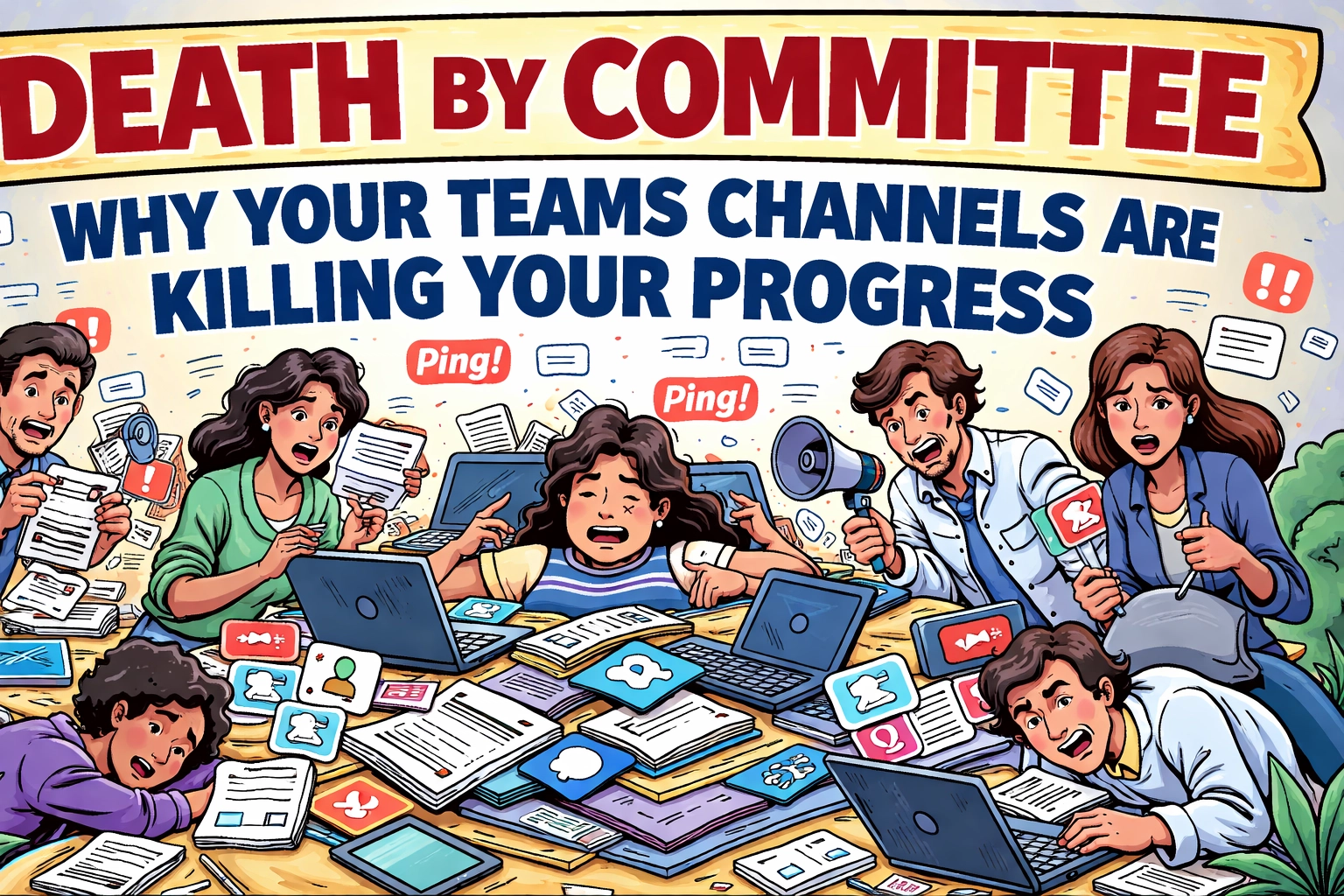
Three weeks later, the idea is buried under a Confluence page nobody reads, a Teams thread with 47 replies, and a "discovery meeting" that got rescheduled twice.
The idea isn't dead. It's worse than dead. It's in progress.
Welcome to the Scoping Trap: where process becomes procrastination, and "let's be thorough" becomes code for "let's never actually do this."
The Disease: Paralysis by Process
Let's be clear about what we're diagnosing here.
Structure isn't the enemy. Planning isn't the enemy. The enemy is when process becomes a substitute for action rather than a tool for it.
You've seen it. Maybe you've lived it:
- A 15-minute task balloons into a 3-week "initiative" because someone wanted to "document requirements"
- A simple workflow change requires sign-off from four people who don't actually do the work
- Every decision needs a meeting, and every meeting needs a follow-up meeting
- The Teams channel has 23 unread messages, half of which are people restating the same opinion in slightly different words
This isn't diligence. This is organizational anxiety dressed up as professionalism.
And it's killing your momentum.

The "Too Many Cooks" Problem
Here's one of the most common symptoms of the Scoping Trap: too many hands in the cookie jar.
You know exactly what this looks like. A project that should have one owner suddenly has six "stakeholders." A decision that should take 10 minutes takes 10 days because everyone needs to weigh in.
Teams channels and Slack threads become democracy experiments where every opinion is treated as equally valid: even when it's not.
Here's the uncomfortable truth: Not every voice needs to be heard on every decision.
I've watched 50-person companies run circles around themselves because they treated a $500 software purchase like a congressional debate. I've seen 10-person shops grind to a halt because nobody wanted to be the one to just make the call.
The fix isn't fewer opinions. It's clear ownership.
One person owns the decision. Others can contribute input. But when the owner decides, that's it. Done. Moving on.
If you don't have clear ownership on projects and decisions, you don't have a team. You have a committee. And committees don't ship.
For more on how communication structure (or lack thereof) can derail your business, check out our piece on why clear articulation matters in IT support.
The Opposite Problem: No Structure at All
Now, before you run off and burn your project management tools in a cleansing fire, let's talk about the other extreme.
Some businesses: especially scrappy Phoenix startups and small shops trying to scale fast: swing the opposite direction. No process. No documentation. Just vibes and Slack messages.
"We move fast around here."
Sure. Until someone leaves and takes all the institutional knowledge with them. Until a client asks for documentation you don't have. Until you realize three people have been working on the same problem for a week without knowing it.
No structure isn't freedom. It's chaos with good PR.
The goal isn't to eliminate process. It's to right-size it.
A lack of structure is just as much of a progress killer as too much of it. The difference is that over-process feels productive (meetings! documents! alignment!), while under-process just feels chaotic.
Both leave you in the same place: not moving forward.

Finding the Line: The "Just Do It" vs. "Scope It" Framework
So how do you know when something needs a full scoping exercise versus when you should just get it done?
Here's a simple framework we use when advising small business owners across Scottsdale and the greater Phoenix area:
Scope It If:
- It touches multiple systems or departments
- Failure would cost significant money, time, or reputation
- It requires budget approval or vendor involvement
- It will take more than a week of focused effort
- The person doing the work isn't the person who understands the requirements
Just Do It If:
- One person can own it end-to-end
- It's reversible or low-risk
- The cost of delay exceeds the cost of imperfection
- You've talked about it in more than two meetings already
- It's been on the "to-do" list for more than 30 days
That last one is important. If something has been sitting on a list for a month, it either needs to get done this week or it needs to be killed entirely. Zombie tasks: things that are technically alive but never moving: are a sign that your process is failing you.
The Real Cost of Over-Scoping
Let's talk about what the Scoping Trap actually costs you.
Time. Every hour spent in a planning meeting is an hour not spent executing. If you're a 10-person company and you pull 5 people into a 1-hour "alignment session" every week, that's 260 hours per year. At $50/hour loaded cost, that's $13,000 annually: just in meetings.
Momentum. Teams that ship fast build confidence. Teams that plan forever build doubt. The longer something sits in "planning," the less likely it is to ever happen.
Talent. Your best people want to do things. They didn't sign up to argue about Gantt charts. Over-process drives away doers and attracts process-lovers. Guess which ones actually grow your business.
Competitive edge. While you're scoping, your competitor is shipping. In markets like Phoenix: where small businesses are growing fast and competition is real: speed matters.
The Scoping Trap isn't just annoying. It's expensive.
How to Break the Trap
Here's the playbook:
1. Assign Single Owners
Every project, every decision, every initiative gets one owner. That person has final say. Input is welcome. Consensus is not required.
2. Set a "Scope Ceiling"
If the planning phase takes longer than 20% of the estimated execution time, you're over-scoping. A 5-hour task doesn't need a 2-hour planning session.
3. Kill Zombie Tasks
If it's been on the list for 30+ days and nobody's touched it, either do it this week or delete it. No more "we'll get to it eventually."
4. Limit Communication Channels
One channel per project. One thread per decision. If people are having side conversations in DMs, your structure is failing. Centralize or lose control.
5. Default to Action
When in doubt, do. Imperfect progress beats perfect paralysis every time.
The Bottom Line
Structure is a tool. Like any tool, it's only useful when applied correctly.
Too much structure and you drown in process. Too little and you drown in chaos. The businesses that win: especially here in the Valley, where growth is fast and resources are tight: are the ones that find the line and walk it deliberately.
Not everything needs a scope. Not everything needs a meeting. Not everything needs six opinions.
Some things just need to get done.
If your team is stuck in the Scoping Trap: or swinging the other way into chaos: it might be time for a reset. Sometimes an outside perspective from a small business AI consulting partner in AZ can help you see where your process is helping and where it's just noise.
Ready to stop planning and start doing? Book an intro call and let's talk about what's actually slowing you down.